
The streets were unusually light.
I arrived an hour early to secure a parking space and claim a front-row spot for photos and notes. Spring training is over. The Blue Jays have headed north. The snowbirds have followed. Cinco de Mayo marks the end of festival season here in Dunedin. The next one does not begin until October.
It was a lovely evening—just like any other in our little coastal town. A sea breeze. Clear skies. The kind of night that reminds you why you live here.
And then, slowly, the locals began to trickle in.
The Crowd Gathers
After work. After school. Families arrived with folding chairs and blankets. Friends and neighbors filled Pioneer Park, settling in for a cultural show hosted by the one and only Tina of Casa Tina’s Restaurant.
She began by introducing herself. And then she told a story.

Tina and Javier’s Story
Back in 1984, in Miami, Florida, Tina was a waitress. Her future husband, Javier Avila, was a cook. They met in a restaurant, fell in love, married, and soon had their first child on the way.
They made a choice. Leave Miami. Find a more wholesome environment to raise their family. Lay down roots somewhere that felt like home.
They chose Dunedin.
Through hardships and labor of love, they raised their children and built a successful restaurant—one that just celebrated 34 years of hosting the Cinco de Mayo celebration for our community.
Tina took a moment to educate the crowd: Cinco de Mayo is not Mexican Independence Day. (That is in September, and Casa Tina’s will celebrate it then too, with specials and festivities at the restaurant.)
She was honest about the scale of the event. It is a very large undertaking, she explained, involving her entire staff and local city resources. It is expensive to put on. But she and her family are grateful to do it for the community of Dunedin.
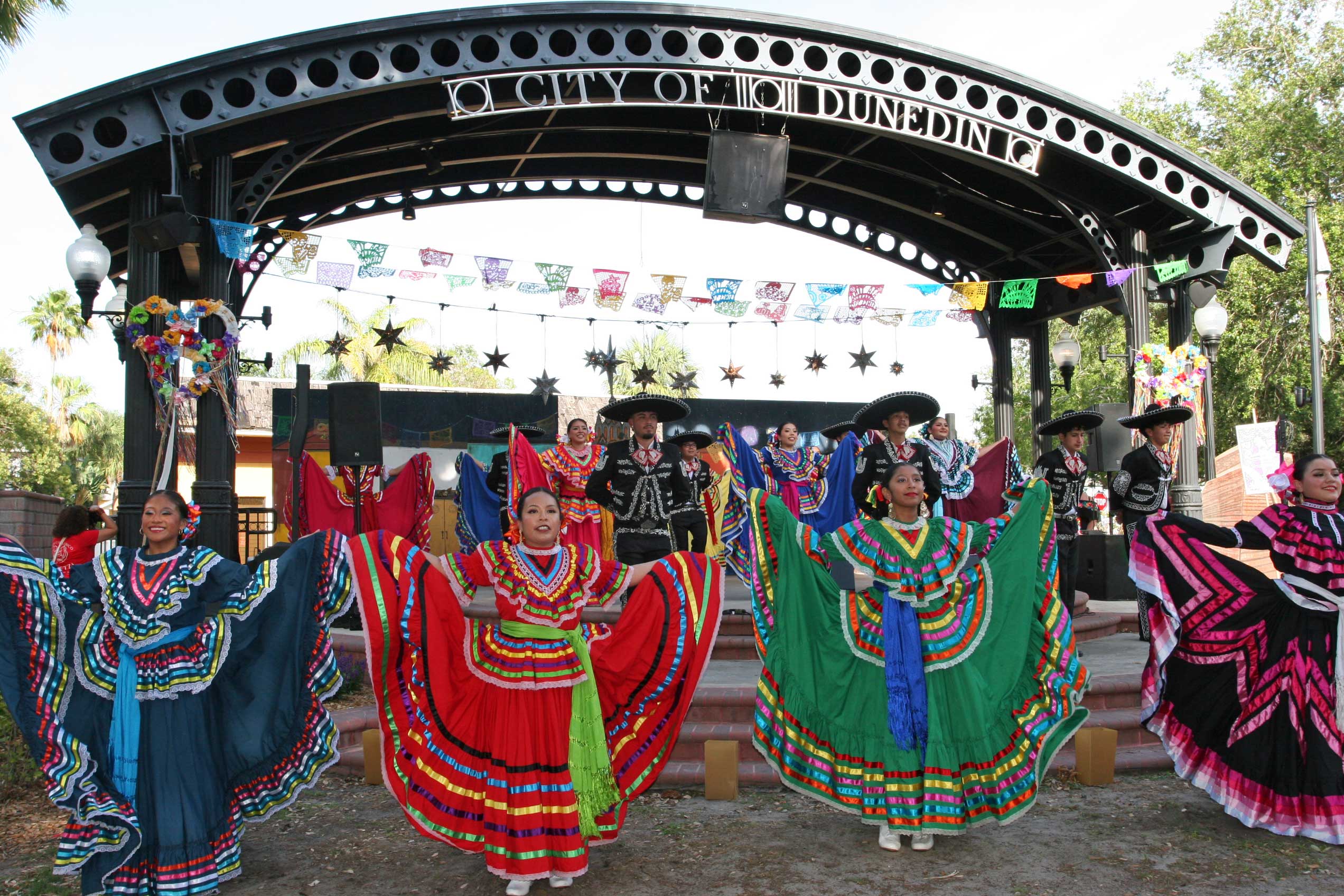
Then she introduced the young dancers who would be performing—explaining that each group would represent different states of Mexico, with different styles, different costumes, different traditions.
The Dances of Mexico
The show began.
The colorful costumes were like eye candy. I was so impressed by these young performers. They moved with precision, with joy, with a pride that filled the park.


One performance, in particular, stood out.
A group of dancers, dressed as old men with wooden canes and wide-brimmed hats strung with colorful ribbons, hobbled onto the stage. They moved slowly at first—shuffling, leaning on their canes, playing the part.
Then, suddenly, they burst into an energetic, almost playful dance. Stomping their feet. Twirling their canes. Moving with surprising agility.
This traditional dance is called “La Danza de los Viejitos” —The Dance of the Little Old Men. It is a joyful, humorous reminder to cherish our elders and celebrate life.


I took so many photos.
The Puppet Parade
Just as the sun began to set, the energy in the park shifted.
A procession began to form near Casa Tina’s. Giant mojiganga puppets—colorful, whimsical, larger than life—rose above the crowd. And leading the way, keeping time with every step, was the Tarpon Springs High School percussion ensemble.
Their drums echoed off the buildings. The rhythm was infectious. Children ran alongside the puppets. Adults pulled out their phones to capture the spectacle. The parade wound its way through the crowd, gathering people as it moved, until it reached the main stage.


It was dusk. The lights strung through the trees had just begun to glow. And waiting on the stage was Orquesta Infinidad—a 12-piece salsa band ready to play until 10 p.m.
Orquesta Infinidad


This was not just any local band.
Orquesta Infinidad is led by Pedro Bullaudy, a Cuban-born musician and bandleader who has served as the driving force behind the Tampa Bay area’s salsa scene for over 20 years . He has shared the stage with Latin music giants like Eddie Palmieri and the Fania All-Stars. His band has performed twice at the Super Bowl, at the Clearwater Jazz Festival, and in a Netflix film.
In 2018, Bullaudy received the Florida Folk Heritage Award, the state’s highest honor for folk artists, recognizing his role in introducing salsa to a wider Tampa Bay audience and establishing Orquesta Infinidad as a “cultural and musical icon” for the region.
On this night, in Pioneer Park, under the white lights and Mexican paper streamers, they did what they do best: they got the crowd moving.
The Dance Begins


The salsa band struck up their first song. The rhythm was unmistakable. Couples formed. Strangers became dance partners. Children twirled under the trees, their laughter mixing with the horns and the congas.
It was not a large crowd by spring training standards. But it was the perfect crowd for a Tuesday night in May.
Locals, mostly. Families. Neighbors. People who know that when Tina says she is putting on a show, you show up.
I stayed until the last song. Orquesta Infinidad played on. The dancers kept dancing. The lights swayed in the breeze.
Until September
Tina reminded us to come back in the fall for Mexican Independence Day. I will be there with my camera.
For now, I have these photos. These notes. This memory of a night when a small coastal town gathered in a park to celebrate a culture that is not our own—but that we are lucky enough to share, thanks to a waitress and a cook who fell in love in Miami and chose Dunedin as home.
That is the real story of Cinco de Mayo in Dunedin.
Next Article:


Discover more from The Suntropolitan
Subscribe to get the latest posts sent to your email.