
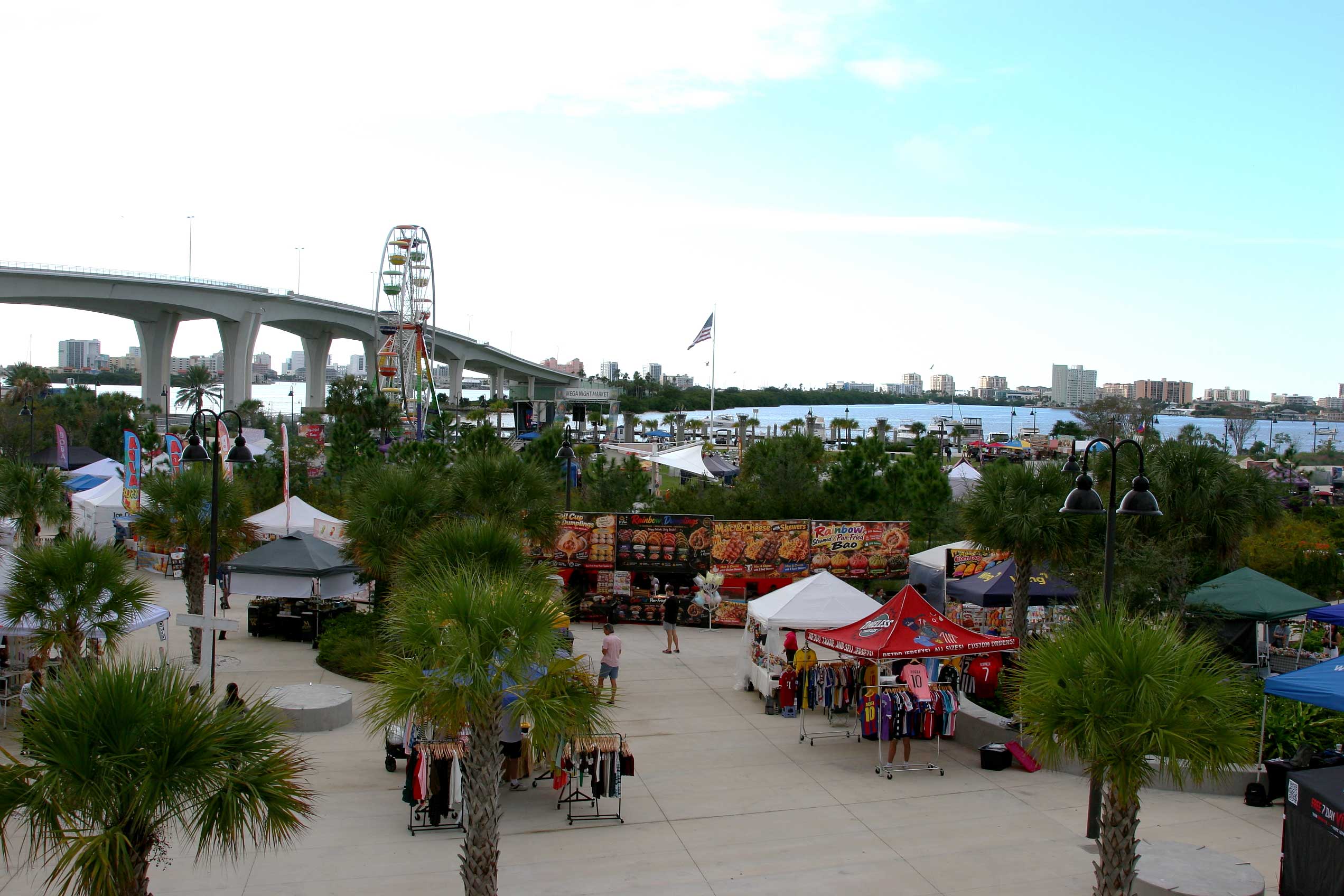
Down along the waterfront, the Mega Night Market spreads across Coachman Park, transforming it into a bustling open-air food hall. Parking sits beneath the Clearwater Memorial Causeway Bridge, and from there the market unfolds along the park’s paths and lawns. If you are near the coast and looking for street food ranging from Asia to the Caribbean, this is the place to be.
Family-friendly and lined with spots to sit, eat, and take in the view of Clearwater’s Intracoastal Waterway on a cool fall evening, the market feels like a small act of defiance—a gathering of food vendors, families, and neighbors in a part of town that has been waiting a long time for a reason to come together.
A Downtown That Used to Be Different
To understand why a night market under a bridge matters, you have to understand what downtown Clearwater used to be. Cleveland Street was once the heart of the city: a walkable corridor of shops, diners, a movie theater, and steady foot traffic. But in 2005, the new high-span Clearwater Memorial Causeway Bridge shifted State Road 60 traffic south, leaving the historic retail core high and dry. The cars that once rolled past downtown storefronts now speed straight over the bridge toward Clearwater Beach without ever looking down.


In the years since, the city has spent millions trying to bring people back—an $84 million makeover of Coachman Park, a new waterfront amphitheater in The BayCare Sound, a new City Hall, and The Ballad Hotel breaking ground near the water. The vision, known as Imagine Clearwater, is real, and it is funded.
Yet the streets between those shiny new anchors remain quiet.
The Force That Shapes the Silence
There is a reason for that silence, and it is not a secret. It is just rarely said plainly.
Downtown Clearwater is home to the Church of Scientology’s spiritual headquarters. The church arrived in the late 1970s, purchasing the Fort Harrison Hotel and the Clearwater Bank building. In the decades since, it has become the largest property owner in downtown, and its footprint has continued to grow. In 2019, the Tampa Bay Times reported that the church had doubled its downtown holdings through parishioner-led purchases. More recently, the church itself acquired four additional parcels on North Fort Harrison Avenue for $5.775 million.
The result is a downtown where a significant share of the real estate is held by an organization that is not driven by retail commerce. Storefronts sit empty; buildings are held rather than leased. Residents and former business owners have described the impact in blunt terms. Former downtown property owner Festus Porbeni told WUSF, “It looks pretty empty. It looks… literally like a ghost town.”
The church disputes that characterization. In a 2025 filing, it described itself as the largest taxpayer in Clearwater and Pinellas County, citing more than $9.6 million in annual property taxes and roughly $917 million in annual local economic activity. Both things can be true: the church is a major economic contributor and a dominant landowner whose presence shapes the character of downtown.
What is not disputed is the outcome. A downtown defined by a large, inward-facing institutional footprint struggles to sustain the small, outward-facing businesses that make a neighborhood street feel alive.

Why the Night Market Matters
This is why the Mega Night Market matters—not because it solves the problem, but because it refuses to accept it.
The vendors setting up beneath the bridge at Coachman Park are not waiting on a master plan. They are bringing food, culture, and energy to a corner of Clearwater that is too often bypassed. They are giving families a reason to spend a cool fall evening downtown, proving that people will show up when there is something worth showing up for.


City leaders know this. Clearwater’s Community Redevelopment Agency runs a Business Spotlight program designed to promote locally owned businesses in the downtown corridor, while the Downtown Development Board helps fund pop-up markets and community events. The tools exist, and the will exists. What remains is the harder question: how do you rebuild a thriving downtown when so much of the ground beneath it is held by someone else?
A Personal Note
I went to the Mega Night Market for the food. I left thinking about the vendors.
They arrived on a Saturday evening, pitched their tents under a bridge, and did the work of making a quiet stretch of downtown feel like a community again. They did not wait for permission from the larger forces shaping the city. They just showed up.
If you are near the coast and looking for street food with an incredible view, go. Support the vendors, sit by the water, and enjoy the evening.
And as you eat, look around. Notice what is there, and notice what is not. The contrast tells a story about Clearwater—one that is still being written.
Next Article:


Discover more from The Suntropolitan
Subscribe to get the latest posts sent to your email.